WACV 2027Main Track
Pixels-to-Phase
Reliability-Aware Latent State-Space Modeling
for Contactless Respiratory Estimation
University of Maryland, Baltimore County
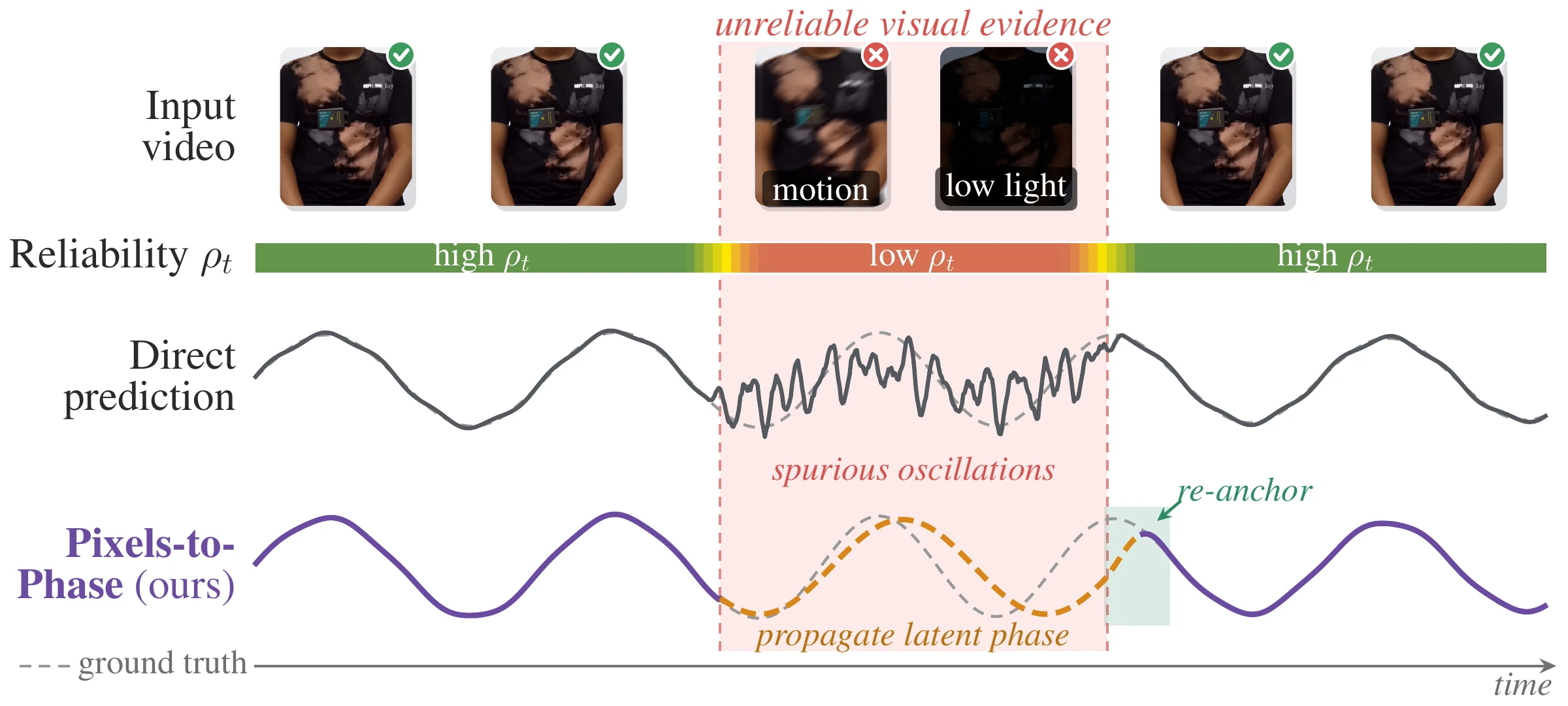
Pixels-to-Phase treats breathing as a hidden phase on the unit circle. Each frame, it predicts the phase from learned dynamics, then corrects it with the video only as much as the video can be trusted.
Abstract
Contactless respiratory estimation from video is challenging because respiratory motion is weak, spatially localized, and easily corrupted by nuisance motion and poor visual conditions. We introduce Pixels-to-Phase, a reliability-aware latent state-space model that represents respiration as a partially observed phase process and separates temporal state propagation from observation-dependent correction. The method localizes persistent respiratory support, constructs visual phase observations from complementary mechanical and semantic cues, and uses estimated observation reliability to control how strongly each visual observation updates the latent respiratory state. Persistent motion evidence and semantic observability therefore contribute to measurement construction, while temporal consistency and motion-quality cues determine when that measurement should be trusted. This formulation preserves short-term respiratory continuity when visual evidence is unreliable while allowing the state to re-anchor when informative observations return. Across RGB, NIR, and thermal benchmarks, Pixels-to-Phase reduces average respiratory-rate MAE from 1.69 BPM for the strongest baseline to 1.51 BPM. Held-out-dataset evaluation further demonstrates consistent improvements across changes in sensing modality, subject population, and acquisition conditions. Targeted analyses show that reliability-aware correction is particularly beneficial under degraded visual evidence while the latent state remains responsive to genuine respiratory transitions.
Motivation
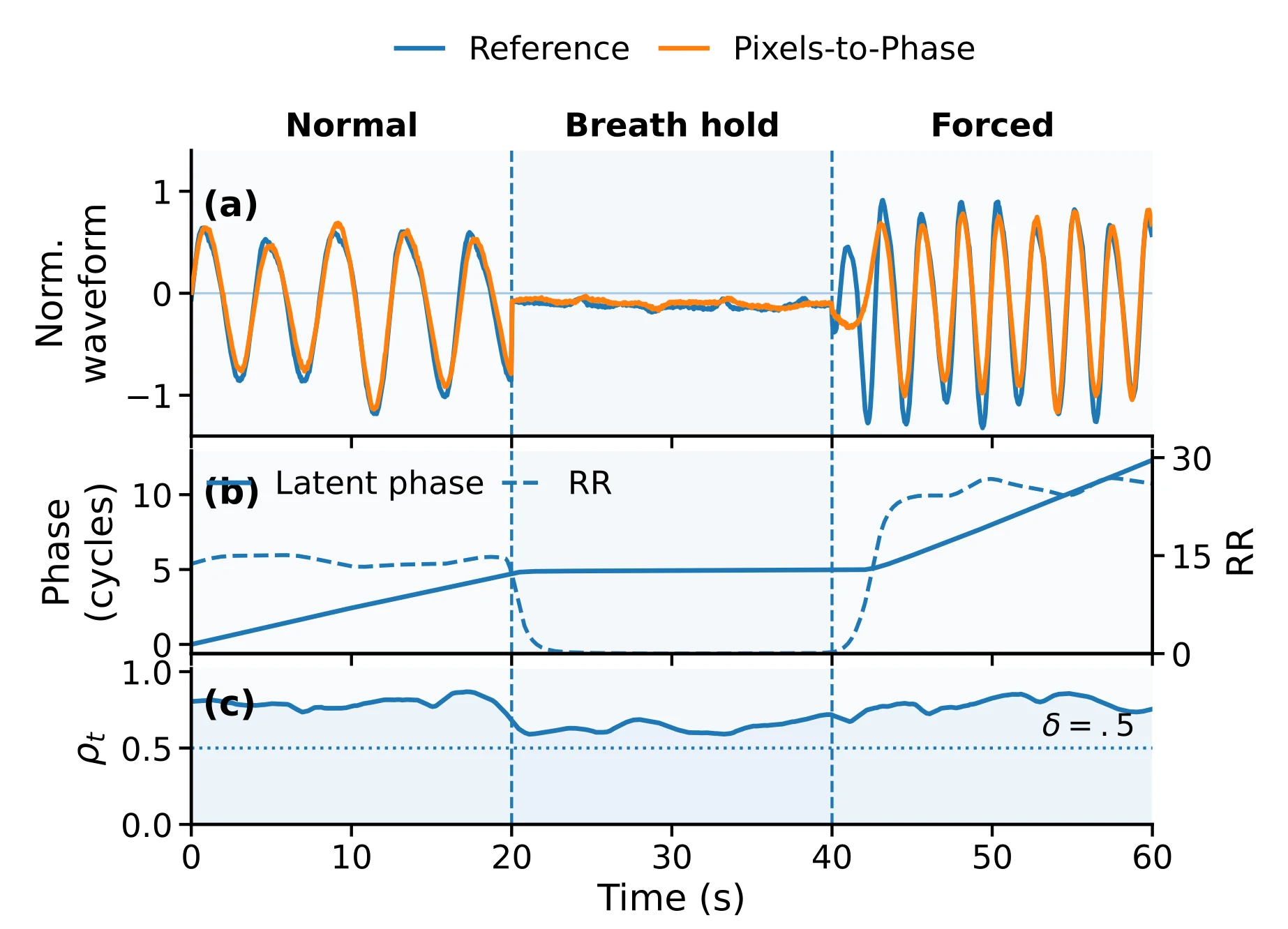
Breathing shows up in video as a few pixels of chest, shoulder and clothing motion. Camera shake, a moving hand or a dark room can swamp it for seconds at a time. A model that maps each frame straight to a waveform cannot tell an unreliable frame from a real change in breathing, so it follows the noise. Pixels-to-Phase keeps a latent respiratory phase, carries it through unreliable intervals and re-anchors when reliable evidence returns.
Method
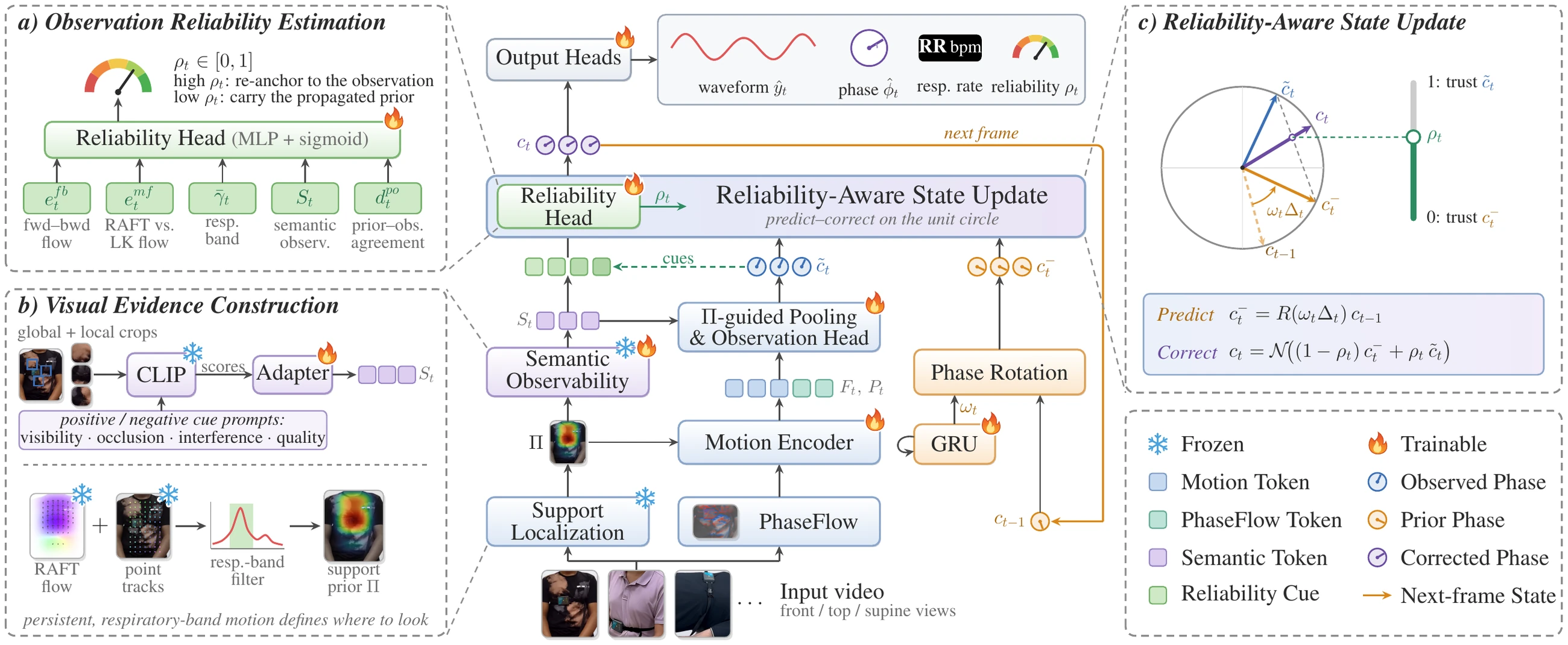
Respiration is modeled as a partially observed phase process whose state lies on the unit circle. The model propagates this state with learned dynamics, builds a visual observation of it from motion and semantic cues, and uses an estimated reliability to decide how much that observation counts. Select a component to highlight it in the figure.
Four components, one causal loop
Support localization decides where to look. Visual evidence construction turns that region into a phase observation . Phase dynamics rotate the previous state into a prior . A reliability head scores the current observation, and the update blends prior and observation by that score. All updates are causal. On a single NVIDIA H200 the full pipeline processes about 207 frames per second, and the recurrent update takes about 1.8 ms per frame.
1. Support localization
Dense RAFT-Large flow on ten sampled frame pairs proposes anchors, and long-range point tracking follows them. A trajectory is kept only if it is persistent, forward–backward consistent and concentrated in the 0.10–0.70 Hz respiratory band. The kept tracks and a dense temporal-consensus mask form the support prior , which tells later stages where persistent, breathing-like motion is.
2. Visual evidence construction
Inside the support, PhaseFlow projects coarse-to-fine Lucas–Kanade displacement onto the image gradient, giving signed mechanical evidence aligned with image structure. A two-branch motion encoder adds learned spatiotemporal features, and a frozen CLIP ViT-B/16 scores surface visibility, occlusion, interfering content and acquisition quality. Support-guided pooling combines them into the phase observation .
3. Phase dynamics
A GRU over past states predicts the breathing rate , constrained to the respiratory range, and the previous corrected state is rotated forward by it. This prior keeps the rhythm going when the current video is uninformative: without new observations, waveform correlation remains 0.92 one second ahead and 0.85 three seconds ahead.
4. Reliability-aware update
The reliability head reads semantic observability, forward–backward flow inconsistency, RAFT versus Lucas–Kanade disagreement, respiratory-band concentration and prior–observation disagreement, and outputs . High re-anchors the state to the video, and low keeps the propagated prior. Waveform, phase, rate and reliability are read from the corrected state; the rate uses frames above the update threshold .
Interactive demo
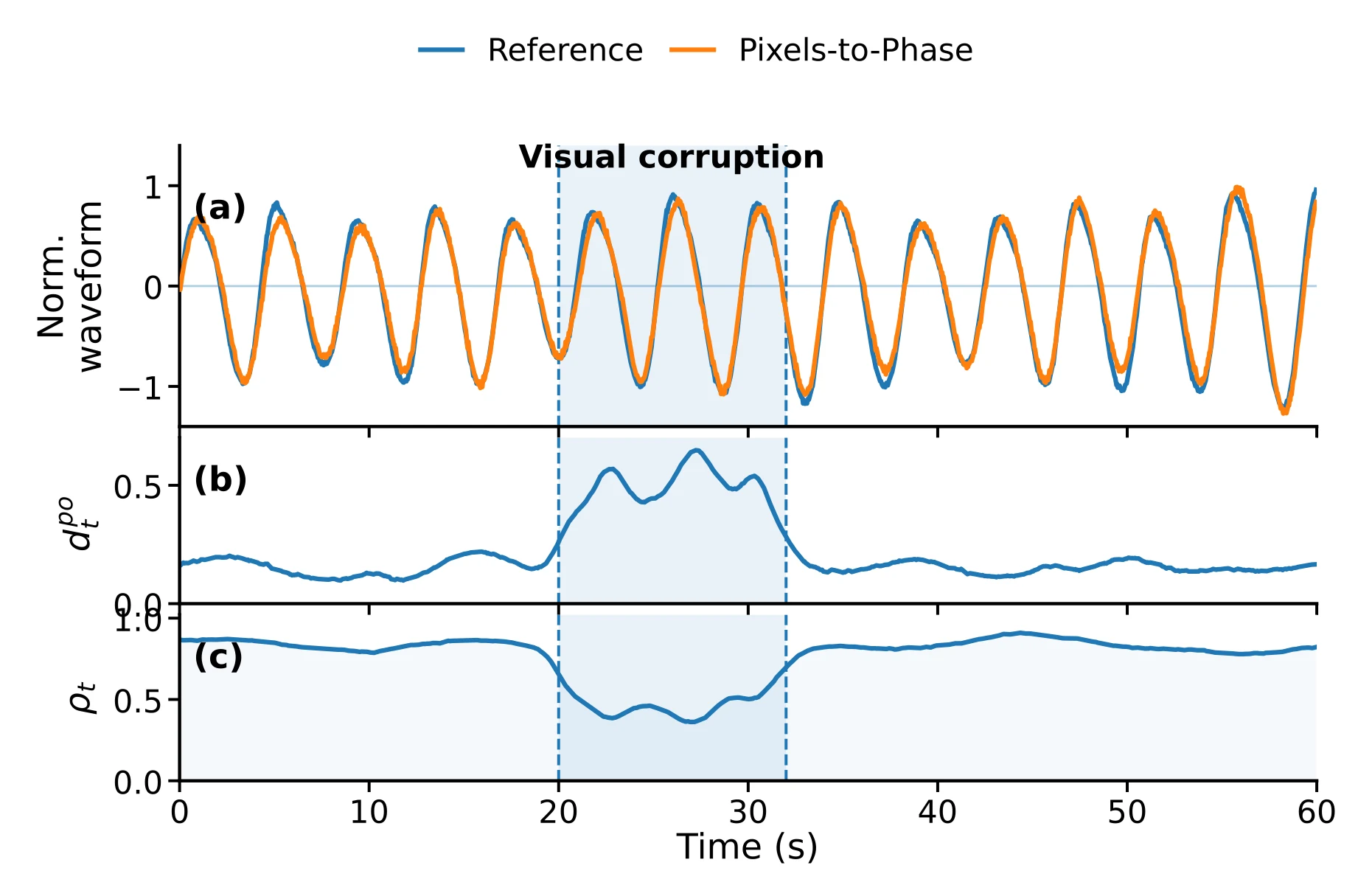
Corrupt the video or set the reliability yourself, and see how the update in Eq. 17 balances the propagated prior against the visual observation.
- ground truth
- direct prediction
- prior
- Pixels-to-Phase
- reliability ρ
- Rate, Pixels-to-Phase
- 16.2 bpm
- Rate, direct prediction
- 16.2 bpm
- True rate
- 16.2 bpm
Results
We evaluate on five respiratory video benchmarks spanning RGB, NIR and thermal sensing: AIR-400, MPSC-RR, Sleep, OVRM and our In-House Dataset v1.0. Pixels-to-Phase achieves the lowest average respiratory-rate error, and its gain over FLOW, the strongest baseline, holds when the test dataset is never seen in training.
Table 1. Main results.
Statistical tests, support validation and ablations
| Dataset | Ours MAE | FLOW MAE | ΔMAE | 95% CI | padj |
|---|---|---|---|---|---|
| AIR-400 | 2.18 ± 0.06 | 2.36 ± 0.07 | 0.18 | [0.06, 0.31] | 0.018 |
| MPSC-RR | 1.32 ± 0.04 | 1.58 ± 0.05 | 0.26 | [0.15, 0.38] | 0.003 |
| Sleep | 1.73 ± 0.05 | 1.88 ± 0.06 | 0.15 | [0.03, 0.28] | 0.031 |
| OVRM | 1.05 ± 0.03 | 1.26 ± 0.04 | 0.21 | [0.11, 0.32] | 0.006 |
| In-house | 1.28 ± 0.04 | 1.36 ± 0.04 | 0.08 | [0.01, 0.16] | 0.041 |
| Overall | 1.51 ± 0.04 | 1.69 ± 0.05 | 0.18 | [0.09, 0.27] | 0.004 |
| Support strategy | MAE ↓ | R ↑ | Band conc. ↑ |
|---|---|---|---|
| Random matched | 2.61 ± 0.10 | 0.68 ± 0.02 | 0.39 ± 0.03 |
| Maximum motion | 2.08 ± 0.08 | 0.74 ± 0.02 | 0.48 ± 0.03 |
| Fixed torso | 1.79 ± 0.06 | 0.81 ± 0.01 | 0.61 ± 0.02 |
| Persistent tracked support | 1.36 ± 0.04 | 0.90 ± 0.01 | 0.76 ± 0.02 |
| Variant | AIR-400 | MPSC-RR | Sleep | OVRM | In-house |
|---|---|---|---|---|---|
| Full model | 2.18 ± 0.06 | 1.32 ± 0.04 | 1.73 ± 0.05 | 1.05 ± 0.03 | 1.28 ± 0.04 |
| w/o point tracking | 3.04 ± 0.10 | 2.21 ± 0.08 | 2.49 ± 0.09 | 1.89 ± 0.07 | 2.12 ± 0.08 |
| w/o temporal consensus | 2.57 ± 0.08 | 1.91 ± 0.06 | 2.12 ± 0.07 | 1.71 ± 0.06 | 1.89 ± 0.06 |
| w/o PhaseFlow | 2.44 ± 0.08 | 1.72 ± 0.06 | 2.05 ± 0.07 | 1.55 ± 0.05 | 1.69 ± 0.06 |
| w/o semantic context | 2.31 ± 0.07 | 1.68 ± 0.05 | 1.96 ± 0.06 | 1.39 ± 0.05 | 1.54 ± 0.05 |
| w/o phase dynamics | 2.66 ± 0.09 | 1.96 ± 0.07 | 2.30 ± 0.08 | 1.61 ± 0.06 | 1.92 ± 0.07 |
| w/o reliability gate | 2.27 ± 0.07 | 1.63 ± 0.05 | 1.91 ± 0.06 | 1.42 ± 0.05 | 1.52 ± 0.05 |
| Δ w/o reliability gate | +0.09 | +0.31 | +0.18 | +0.37 | +0.24 |
Analysis
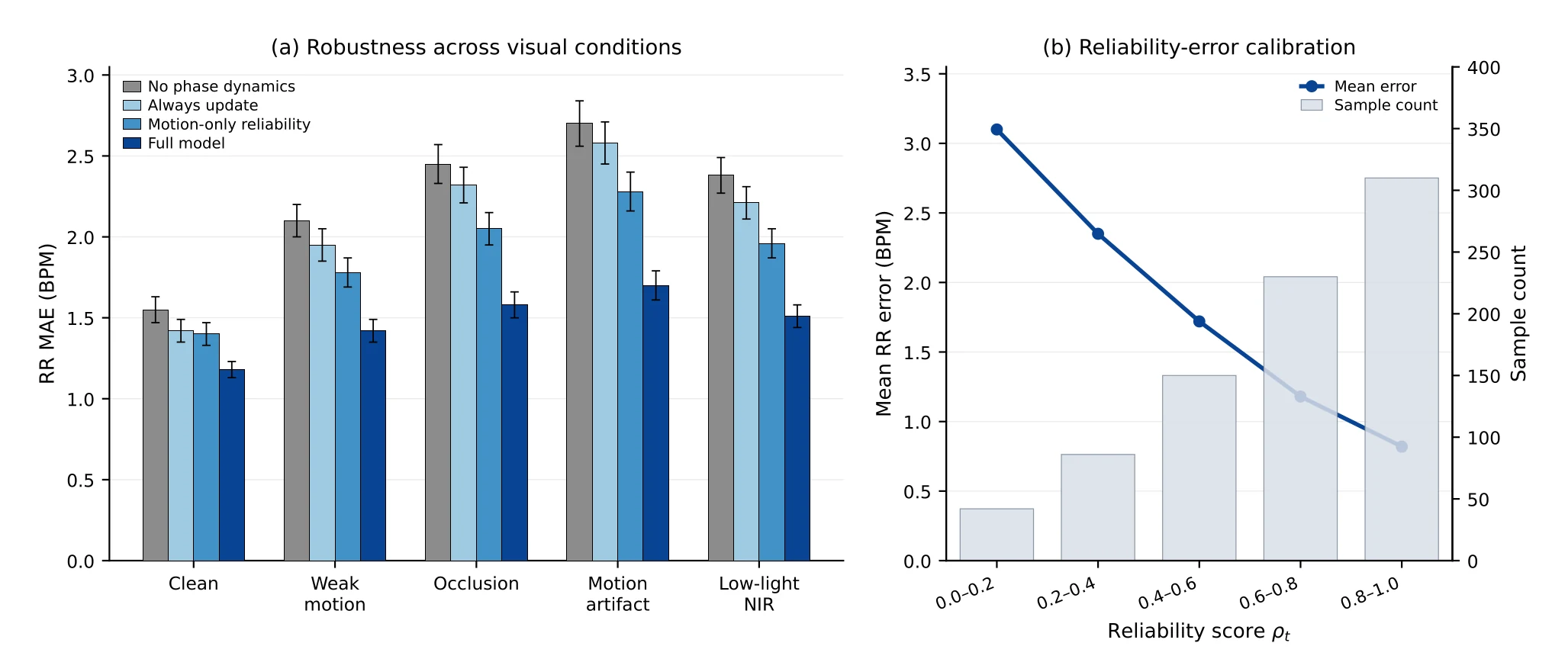
The benefit of reliability-aware correction is small on clean video and grows under weak motion, occlusion, motion artifacts and low-light NIR. Estimated reliability is also calibrated: RR error rises from 1.08 BPM in high-reliability intervals to 1.57 and 2.46 BPM at intermediate and low reliability.
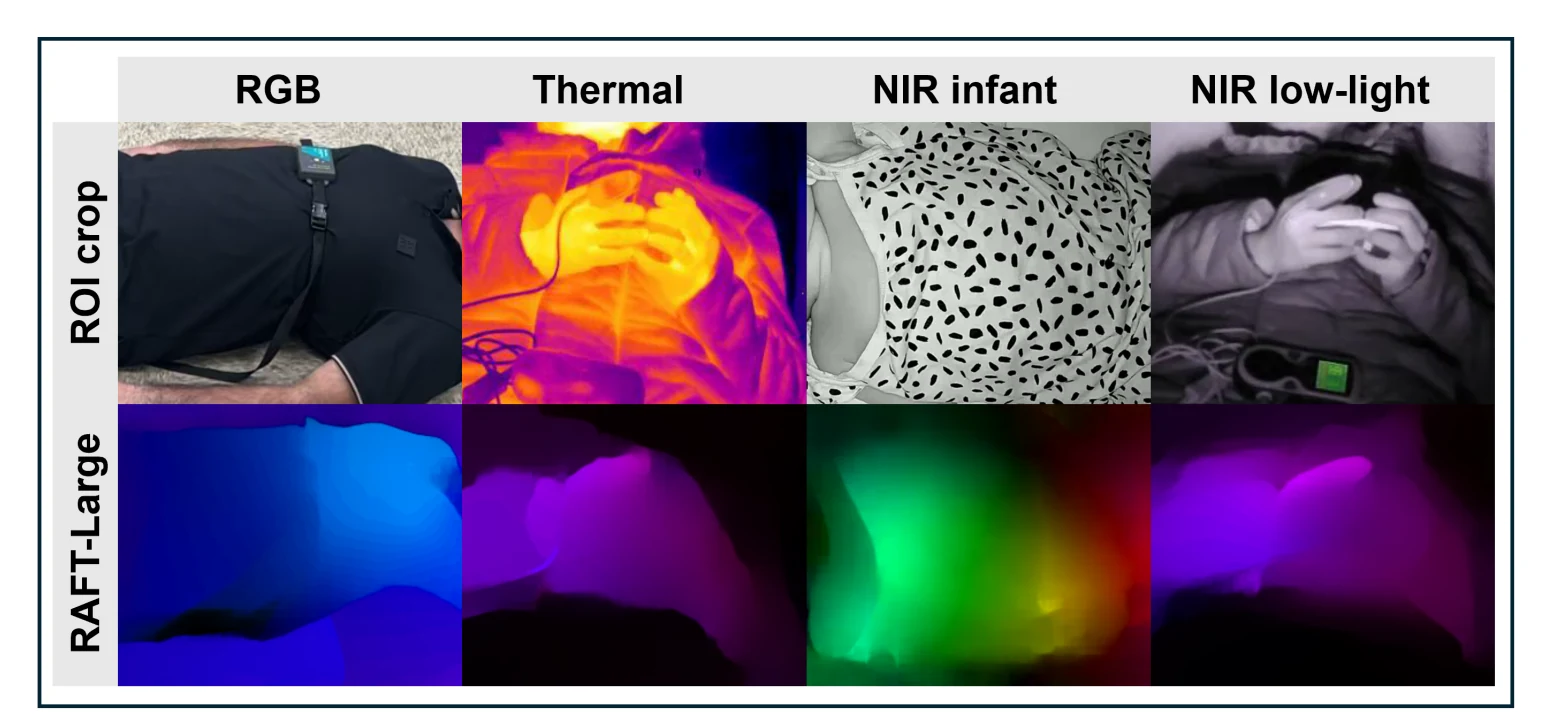
Motion evidence on real recordings
How visible breathing is depends on the sensor and on the distance to the subject. These examples show the respiratory region and its motion fields under different acquisition conditions.
In-House Dataset v1.0 · MPSC-RespView
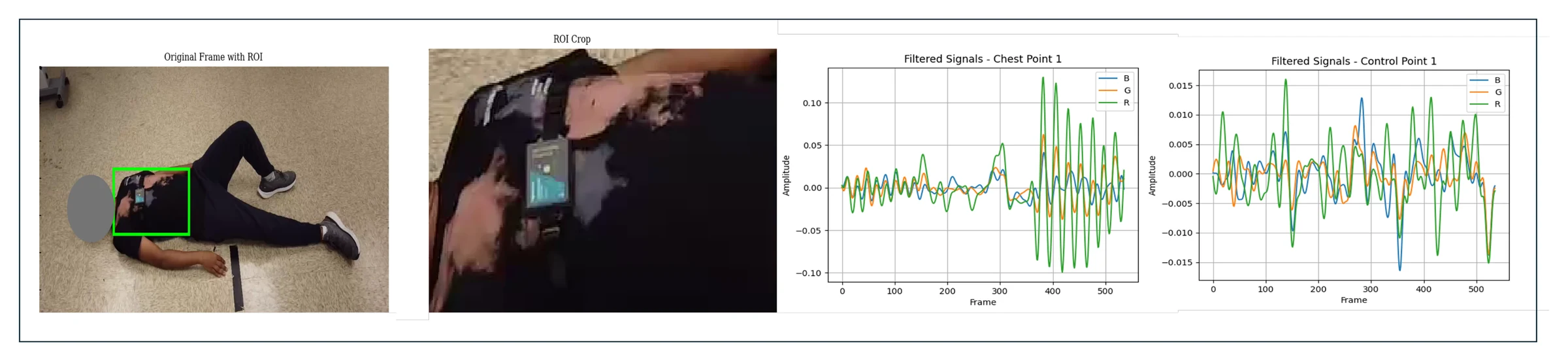
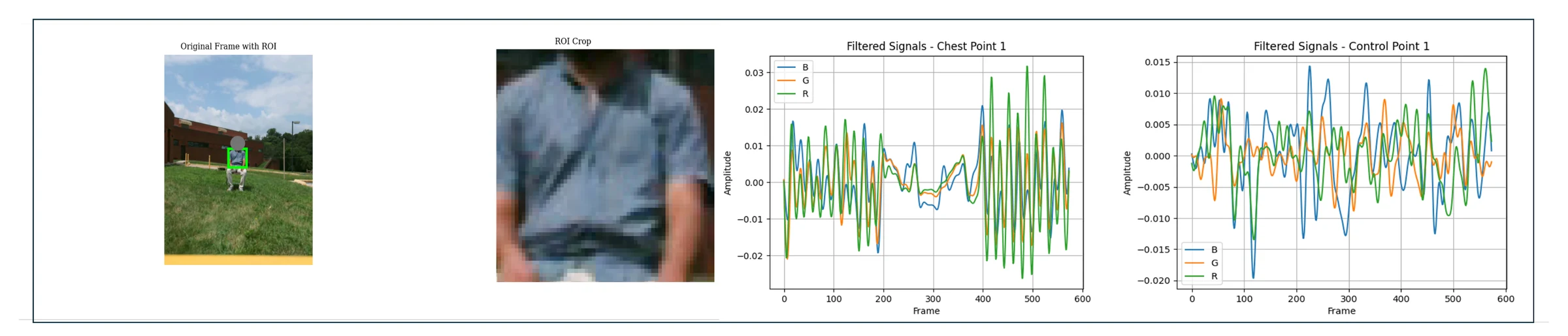
Release in preparationA versioned RGB corpus collected under an IRB-approved protocol with informed consent. It varies the factors that make breathing hard to see: posture, viewpoint, subject–camera distance, illumination, clothing texture and body motion. In the paper it serves as an additional evaluation resource alongside the public benchmarks. It is now released to the research community as MPSC-RespView on Hugging Face, with a data card, statistics and a preview.
- Recordings
- 73 RGB videos: 50 indoor and 23 outdoor.
- Indoor
- Mostly Full HD at 30 fps, about 1.5–5 min each, recorded with a synchronized respiratory belt (belt reference signals are not part of the public release). Spontaneous and paced breathing (slow, regular, fast) in frontal seated, top-angular, backward-view and lying/supine views.
- Outdoor
- One-minute recordings at 4, 5, 6, 7, 9, 11 and 13 m, each with about 20 s of normal breathing, 20 s of breath holding and 20 s of forced breathing.
- Access
- Openly available on Hugging Face under CC BY-NC 4.0 (non-commercial, with attribution). Faces are anonymized and the videos contain no audio or names. Use is subject to the terms of use in the data card, including no attempts to identify participants. The dataset is intended for respiratory-monitoring research, not clinical diagnosis or apnea assessment.
- Contact
- ssakib1@umbc.edu · nroy@umbc.edu
| Dataset | Protocol | Split |
|---|---|---|
| AIR-400 | 6-fold subject-wise | 12 / 3 / 3 |
| MPSC-RR | 5-fold subject-wise | Fold-based |
| Sleep | 6-fold subject-wise | 8 / 2 / 2 |
| OVRM | 5-fold group-wise | Group-based |
| In-House v1.0 | 5-fold subject-wise | Fold-based |
Citation
@inproceedings{sakib2027pixels,
  title     = {Pixels-to-Phase: Reliability-Aware Latent State-Space
               Modeling for Contactless Respiratory Estimation},
  author    = {Sakib, Shadman and Roy, Nirmalya},
  booktitle = {Proceedings of the IEEE/CVF Winter Conference on
               Applications of Computer Vision (WACV)},
  year      = {2027}
}